Muck Glorious Muck
Updated: Sep 29, 2024
Well we did warn that internet can be a little hard to find in Papua! We’re now settled in the Raja Ampat archipelago and have had a little time to catch up after a hectic month. First up, muck diving in Bali.
Whilst well known as a top holiday destination, Bali does not have such a reputation for top class diving (top class meaning a great environment without the disturbance of 100 divers on one site at once!). In fact, the black volcanic sands of east Bali have some great diving if you know where to look and what to look for. What may appear at first to be a boring silty sand slope with a few scattered sea fans and coral colonies is in many cases bursting with unusual lifeforms.
This is the world of ‘muck’ diving – you don’t have to be on the biggest coral reef to have the best dive, many of the strangest and most amazing underwater lifeforms (coloquially known as ‘critters’) are found in volcanic sand areas. The most famous example of this is the Lembeh Strait in Sulawesi, but the area between Kubu and Karangasem (itself an upcoming holiday destination) in East Bali is also getting a reputation as a great critter destination without the hassle of domestic travel through Indonesia.
We stayed at newly opened Villa Markisa right on the beach near Tulamben in the center of the ‘hot zone’ for critters in Bali and enjoyed some great dives focussing on the small, the weird and the ugly!

As dawn breaks over the towering volcanoes of Bali large schools of fish collect on the reefs below.

Colorful contrasts emerge from the negative space of the black sand, here a pink scorpionfish hides in a network of blue sponges.

The place of the confetti of small coloured fish is taken by more quirky ones - here a yellow leaf fish. To complete its camouflage it rocks from side to side in the current. (Just a pity this one is clearly colourblind!)

The also come in pink as well as others colours (but as you can see, still colourblind!)

Peering into the crevices between the rocks reveals more unusual life - an unusual two-spot lionfish.

And they don't come uglier than the giant frogfish - without the lighting on it it really does look like a lump of rock or coral - beware though, they can move extremely fast when there's a meal available...
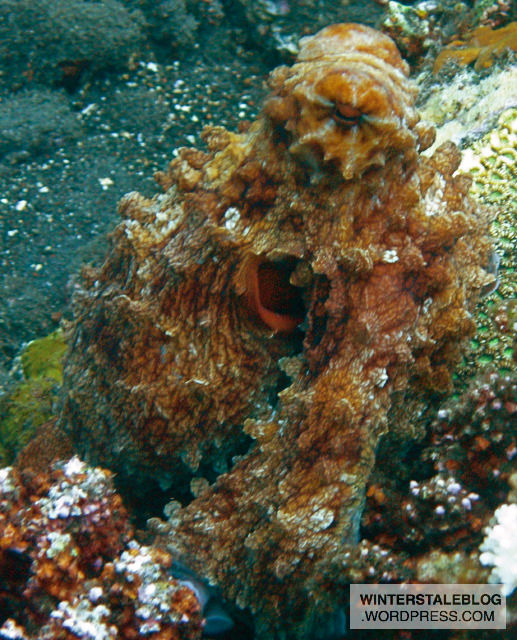
Drifting over the sand after a night of hunting one can also see octopi from time to time in the mornings...

... as well as have close encounters with their psychedelic color flashing cousins the cuttlefish.

A seahorse is always a great find, and so much easier to see against a grey background!

The Ornate Ghost Pipefish is one of the most common critters of the area - this one is in the 'post-pelagic phase' of its life - notice the long filaments extending beyond the fins.

This individual is more mature (see the fins) but note it retains the characteristic behaviour of hanging motionless vertically with the head down in close proximity to other verticals (crinoid arms in this case).

In fully mature specimens the fins and body become more substantial, not that that makes it any easier to see...

Deeper down, rather bigger creatures are moving around such as this squat lobster.

The winner of the All Shrimp and Lobster Beauty Contest has to be the Harlequin shrimp though (about 8cm long).

The camouflage prize however goes to the Gorgonian Shrimp, which hangs out (vertically) in sea fans.

And the variety of shrimp costumes just keeps on coming..!

There are interesting crabs getting into the costume vibe in the hydroids too, this one about 1cm long.

Few crabs however can compete with the 'Orang-Utan crab' which camouflages itself with a coat of algae on its own body.

Of the many nudibranchs this was one of the more interesting.. it's in the Hypselodoris genus, but that's as far as we can get in identifying it at present.


Comments