Journey to Guge – Part II
Updated: Sep 29, 2024
Continued from ‘Journey to Guge – Part I’

Groups of Tibetan antelope are plentiful in some valleys.

Black Necked Cranes can be seen in the wetland and river valley areas as well as eagles, kestrels and other grassland and waterbirds.

And, well, we’re not quite sure what it is… something like a Tibetan Prairie Dog??! Answers in the comments please…
Travelling further west the environment becomes more sandy with enormous belts of sand dunes that sometimes swallow the road and telephone poles. In the marshy wetland areas around and between the dunes there are significant nesting and feeding grounds for migratory birds.

Sand dune and lake panorama, near Paryang.

Geese flying past the sand dunes in the previous panoramic view.

Lakes, sand dunes, mountains.. this area had it all.
These wetlands also act as fertile grazing land for yak, sheep and goat herders. Both settled villagers and nomads gather here below the spectacular snow mountains that separate the valleys.

A Tibetan boy. I moved the lens just in time to avoid fingerprints..!

In a nomad tent at Lake Mansarovar

Tibetan landscapes are on a grand scale (notice the people on the right).
It may look sunny and pleasant weather, but don’t let your guard down, the weather conditions can change rapidly at altitude and can move from a sunny day to stinging windblown clouds of ice crystals and snow covering everything in minutes.

Blowing ice crystal clouds, Tibetan Spring can be harsh!
Driving on through the desert-like sandy regions one finally arrives at the ‘Sand Forest’, an extraordinary sandstone canyon system around 100 miles from the border with India.

The "Sand Forest" a world geological park in remote western Tibet.

Temperatures may be sub-zero, but the light is pretty stunning in the early morning.
Hidden within the Sand Forest down some very twisty, dusty roads is the remote town of Zhada. Situated in the extreme west of Tibet in the area where the Himalaya, Kundun and Ganside mountain ranges come together it’s perhaps surprising that temperatures can reach more than 30 C around Zhada in the summer despite being at around 3,400m altitude.

Across a riverbed from Zhada.
One of the older and most artistically interesting monasteries, Ntho-ling monastery, is located in Zhada. A strict no photography rule is enforced in almost all areas which is a pity given the unusual combination of Tibetan and Indian subjects and styles in the extensive areas of murals and statues in the monastery.

In the shadow of Buddha, Ntho-ling Monastery.
We were able to take a picture of the shadow of the largest Buddha at Ntho-ling, stretching our camera technology to the limit given the extremely low lighting. The picture was taken at ISO 25,600, f 2.8, 1/20 sec hand-held at one stop underexposed to reduce camera shake then digitally corrected.

A kitchen at Ntho-ling Monastery, Zhada.
Beyond the town of Zhada lay one final mystery for us to explore, the Kingdom of Guge. The track is dusty, and a few surprises can await the driver, we were flagged down by someone at the side of the road, then our guide turned to us smiling pleasantly and said in a matter of fact manner “man put bomb in road”. We barely had time to stammer “What?” when a sharp crack sent up dust in front of us … nothing to worry about, just a bit of dynamiting for road development!
The remote region of Guge has apparently been settled for around two thousand years based on current research and evidence of the different eras of occupation is clearly evident even to the casual visitor. The first occupation of which there is significant surface evidence is the occupation by Bonist cave dwellers. (‘Bon’ was the original religion of Tibet before Buddhism as practised today became widespread). Small caves and living areas with alcoves and water-troughs have been carved into the sandstone rock. After a turbulent period during the tenth century in what is now the Kashmir and Ladakh area three groups of people were forced out of their lands and travelled into what is now far western Tibet where new settlements and kingdoms were established. The Kingdom of Guge was one of these kingdoms, the other two remain unlocated as ‘lost kingdoms’. The Kingdom of Guge survived for around 700 years, and according to historical accounts was a green and fertile area which supported in the region of 100,000 people. There are various theories about why the Kingdom fell and why this was so sudden however there is little proof and it remains mysterious.
Guge has a lot of historical significance as many significant teachers of Buddhism coming from India came to Guge as their first point of residence in Tibet.

The Guge Kingdom.
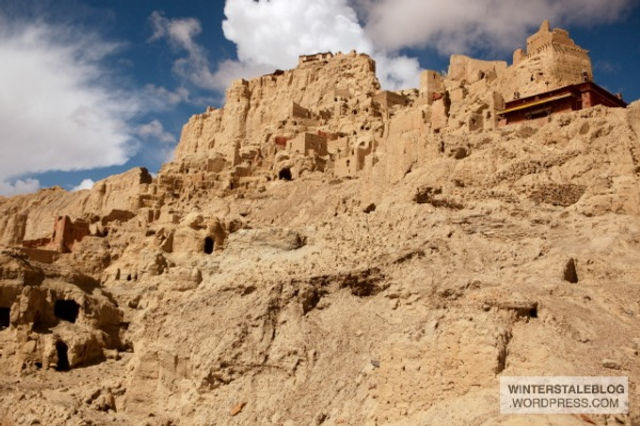
Looking up the hillside at the center of the Guge Kingdom.

Multi-level caves at Guge.
The caves are believed to be mostly from the period before the tenth century, and as can be seen the site is extensive with around 800 caves and walled residences, 28 temples in all and many other special use buildings and sites. Occupants had living quarters according to their social rank, the more important people stayed higher up the hill.

Caves at Guge.
Crouching to enter into the caves one can see carved alcoves and storage areas of many different sizes. Some caves are connected into more extensive and intricate grouped living quarters.

Tunnels inside the hillside at Guge
The core of the Guge Kingdom is set on a steep hill with natural vertical rock walls rising to a platform on which the houses of those with highest rank were situated. It is extremely difficult and dangerous to ascend these cliffs so tunnels were carved into the rock allowing easy access to the administrative center while providing strong natural fortification as only one or two people abreast can climb through the tunnels.

One of the several chapels at Guge.
The most striking aspect of all are the chapels which have original paintings and decorations over a thousand years old. It was disappointing that despite discussions there was again a strict ‘no photography’ rule inside all religious buildings, however it was nice to see the local people want to protect their unique heritage over making quick money from it. (We assume there was no more insidious reason..)
The chapels are opulently painted with gold leaf and mineral colours and are well preserved enough in most cases to see detail while giving an instant sense of their antiquity. The Buddhist paintings are unique for this period in that they have a mix of Tibetan designs as well as gods dressed in Indian clothing and other Indian designs and motifs. Mixed in with the Buddhist paintings there are also Bonist ‘Thangka’ (small paintings). These paintings are currently being studied and preserved by specialists as outstanding examples of their kind.
The most memorable moment came on entering the largest chapel. This dust floored chapel is perhaps 20 metres square, elaborately painted but lit only by sunlight entering the small window areas at the top. As your eyes adjust you start to pick out shapes, but not the shapes of familiar statues. Elaborately decorated 4 metre bodies stand motionless with frozen postures of aggression and grimaces. Moving your gaze beyond the face you are suddenly startled to see the entire stomach is missing with straw pouring out the gaping rough hole, some have arms missing… Buddha’s head lies dusty and decapitated on an altar, the serene smile still on his face. Pages of screwed up and sometimes ripped scripture and straw lie amid piles of rubble in the darker recesses….
What happened?
This is the cultural revolution. In almost all monasteries we visited there were quiet comments about ‘restoration works’ or similar then discussion went onto the intricacies of Tibetan Buddhism. The damage of the cultural revolution has been swept away and replaced with a new coat of paint and new statues. The chapels in Guge seemed to be like a time capsule – shattered statue pieces lay on the floor, the almost overpowering irony of the disembowelled Protector God frozen in grimace looking at the now empty space where the largest Buddha used to be. This is uncensored history and metaphor and the place is all the more poignant and powerful for it.
Guge is a very remote place and ‘tourism’ here is in its early stages. Much remains to be discovered and understood, and given the fragility of the site it must be protected carefully so that this window to the past is not lost. We wish the local community the best for continuing to respect and preserve the magic of this unique place as the road building and infrastructure projects move closer and slowly open Guge to the world.


Comments