Cobourg Peninsula - A Unique Natural Mosaic
The Garig Gunak Barlu National Park (encompassing the entire Cobourg Peninsula and the surrounding marine area) in the west of Arnhem Land has many of the things we look for in an interesting destination - diverse and unusual natural flora and fauna, large wilderness areas and a great mix of habitats. When we went to Darwin we couldn't miss the opportunity to spend some time visiting this amazing but remote national park.
It is accessible by land, sea or road, but whichever way you follow you're sure of an adventure! Travelling by road it is more than 500km from Darwin, a lot of that on unsurfaced roads across wild bush and the 'Stone Country' (see our Kakadu post for a picture of that). Realistically it is a couple of days driving and of course you need everything for all eventualities you - no fuel, water or service areas available here!
For our purposes we flew in and out using the unsurfaced airstrip at Vashon Head to maximise our time in the Park. Cobourg really is wild country and has more than it's fair share of hazardous wildlife, so with the young travellers in tow we were looking for some experienced and careful local guiding rather than self led exploring and days of overlanding.
We stayed at the very comfortable Seven Spirit Bay (one of the Outback Spirit group of hotels) and very much enjoyed their efficient and well run operation with boats, vehicles and experienced guides well capable of supporting some exploration of the wide ranging natural environments, Activities are small group focussed and generally follow an established routine but that's what keeps things running smoothly in such a remote and sometimes harsh environment and gives the best experience.
Amongst the angling community Cobourg is widely famous for it's world class fishing. That seems to be at it's best when the weather conditions are at their hot and humid worst in October/November but we still enjoyed some sea fishing on our visit, catching a large Queenfish.
If the pictures below tempt you, give some thought to what kind of experience you want to take away from your visit - Seven Spirit Bay is enormously comfortable, great food and a really nice swimming pool, but it's of course not a camping trip. If on the other hand, you're looking for that real overlanding and individual camping adventure to remember, take a look at Venture North Safaris - they are also experienced with escorted driving trips to Cobourg and have their own base there.
Safety Note: Don't be misled by the pictures of white sand beaches and turquoise water. There are many crocodiles, sizable sharks, box jellyfish, blue ringed octopus, deadly snakes etc. This is not the place for a conventional beach holiday!

If you come by road then the start of the exciting driving is at Cahill's Crossing - the croc in this picture only grudgingly got off the road for the car - not quite the same as herding some wayward sheep of the road. At low tide the wrecks of several cars that misjudged the tide can be seen washed downstream and half submerged.

If instead you choose to fly you won't need to study the maps carefully to find your way through to the arrivals area and baggage reclaim at 'Vashon Head International Airport'.

If you do choose to fly you'll be crossing the Van Diemen Gulf, tracking along the coast of the Tiwi Islands before you approach the mangrove and reef lined coast of the Cobourg Peninsula.


Many different land and water habitats exist in close proximity along this coastline, both estaurine and bluewater marine.

Finding established coral reef directly under mangroves is very rare in Australia, however Popham Creek in Cobourg is one of the few places in Australia where this occurs.

The beaches of Cobourg are known to support all six species of marine turtle found in Australian waters.


With so few visitors some of the remoter beaches are lined with large shells, coral and sponge skeletons.


Strictly no paddling from these beaches unfortunately, but if you take a boat out or find a good croc safe vantage point and spend a little time you're likely to see some of the marine wildlife, like this large sawfish. Six species of marine turtle, dugongs and manta rays are also seen around here.


The bluewater creeks and mangrove channels that cut into the peninsula from the sea are well worth a look as well (and maybe a bit of fishing), although don't be surprised if you run across a croc or two as well..


The interior is a varied mix of habitats, including lagoons and open grassland to dense fern thickets.


We also saw some beautiful stretches of paperbark swamp (croc safety - don't get too close to the water, use a long lens!) and the Nypa Palms that also grow here (these are an Asian palm, only growing in a couple of small isolated populations in Australia).


Taking a walk into the bush, if you are there in later July you may see large patches of the bush turning pink with the flowers of the Turkey Bush, they have a pleasant scent similar to citronella. Rustling quietly through the undergrowth you might come across rainbow pittas and up in the trees the red winged parrots. With a little luck you may also come across the banteng - an endangered wild bovine originating from Southeast Asia - the world's largest population of these is now in the Cobourg Peninsula.
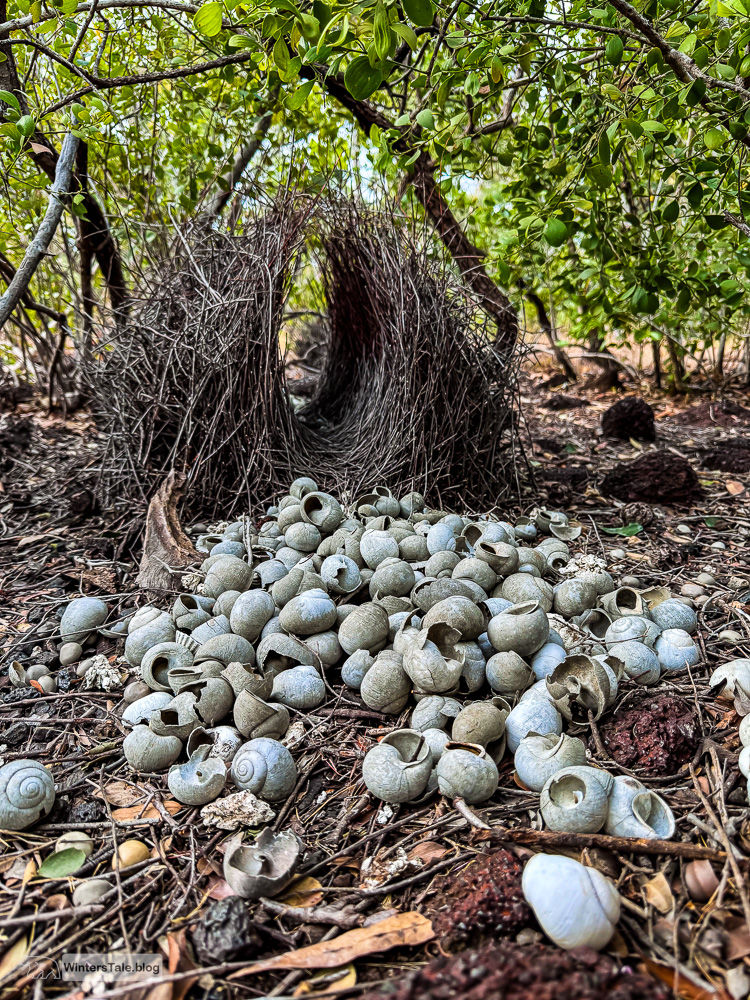
There's a lot to see in the smaller details too. The Great Bowerbird constructs intricate arching bowers and then individually selects and gathers snail shells and other prized items to make a display in front of the bower.

The sap of the Melville Island Bloodwood tree does indeed look like blood.

You also need to be very careful about brushing against any leaves. Green ants make their nests amongst the leaves, anchoring leaves together and then using their own larvae as a form of 'glue stick' to fasten the leaves together with silk like threads. If you unwittingly brush against a nest the ants will immediately come rushing out ready to attack the aggressor. If you're into bush tucker that may be what you want (eating green ants is a local aboriginal medicine for a headache, and Green Ant Gin is definitely also 'a thing'!).

Around the edges of the mangroves, "long bum" shells pile up, also good eating if you're on the lookout for bush tucker.

Some amazing nature and environments for sure, but just a couple of days will quickly bring the realisation of how hostile and hazardous this place could be to the unfamiliar and unprepared. This makes the efforts and hardships of the attempted British settlement in the area all the more amazing and tangible. A visit to "Victoria Settlement" (established in 1838 disbanded in 1849) adds a historical element to time on the peninsula.


After hot walks through the bush and boat trips around the coast it was nice to know we had a comfortable place to return to whilst the wildlife spotting continued. The sharks above tend to hang around the jetty where the boats are boarded (don't fall in!) and the resident croc here is one of the reasons the beach below the restaurant is sadly out of bounds!


Comments